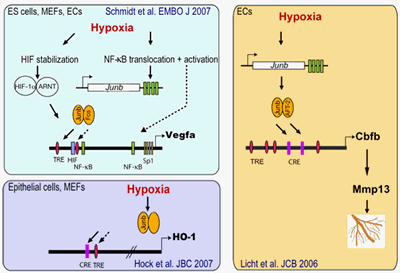
Junb is a subunit of the AP-1 transcription factor complex that mediates gene regulation in response to a plethora of physiological and pathological stimuli. In order to dissect the individual functions of Junb in vivo, we have previously generated complete and conditional loss of function mutations in mice. Our own studies and work of others showed that critically balanced Junb levels are essential for normal physiology. Loss as well as over-expression of Junb could be associated with numerous pathophysiological alterations and disease states. Complete as well as endothelial-cell specific ablation of Junb resulted in very similar angiogenic defects with subsequent embryonic lethality suggesting that Junb has a critical role in angiogenic processes. During the first funding period we identified Junb as the receiving end of hypoxia- and hypoglycemia-induced signaling through NF-kB-dependent and independent pathways, respectively. Most importantly, we could shown that Junb is a critical regulator of several pro-angiogenic molecules including the major angiogenic growth factor Vegfa, the CBF transcription factor subunit Cbfb and its target Mmp13, as well as the heme degrading enzyme heme oxygenase 1 (HO-1). We could demonstrate that impaired expression of these molecules is causative for the observed defects in endothelial cell morphogenesis and sprouting angiogenesis observed for Junb-deficient embryos, tissues and endothelial cells analyzed in vivo and in vitro. Preliminary data based on the in vitro analyses of Junb-deficient mouse embryonic fibroblasts (MEFs) and vascular smooth muscle cells (VSMCs) imply that Junb is additionally involved in the regulation of cell migration, contraction and vascular stability through the control of novel putative targets, namely myosin light chain-2 (MLC-2/Myl9) and Pdgfb. Thus, for the applied funding period, we will In continuation of this work (1) decipher the role of Junb in the migration of vascular smooth muscle cells and for the stability and contractility of vessels; (2) use conditional Junb mouse mutants to identify key components in the communication between tumor cells, ECs and other stromal cell types that promote tumor growth and progression; (3) investigate the role of Junb in the regulation of EC-specific miRNAs and its impact on tumor angiogenesis and vascular diseases. |